
Inside the
Fall Issue:
All Because
of Harry...
Harry Chapin
Run Against Hunger
Be Not Afraid
An Extraordinary
Friendship
Larry Austin Helps Keep
Harry’s Long Island
Dreams Alive
Fighting AIDS
in Ethiopia:
One Person
Making a Difference
Bonnie Raitt
Honored With
Chapin Humanitarian
Award
Readers Help
Those Affected by
Hurricane Katrina
Chapin Family
& Friends Plan
Concert in NYC
To Benefit WHY’s
30th Anniversary
Goat Tales
Doing Something
Letter to the Editor
WHY Hosts Free
Anti-Hunger Forum
October 18th
Country Store
Owner Celebrates
“Harry Chapin Weekend”
Circle! Calendar
Click below
to read previous
issues of Circle!
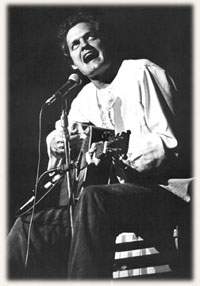 |
| Harry Chapin (photo by Steve Stout)
|
All Because of Harry...
“The future is a construct that is shaped in the present, and that is why to be responsible in the present is the only way of taking serious responsibility for the future. What is important is not the fulfillment of all one’s dreams, but the stubborn determination to continue dreaming.”
~ Gioconda Belli, The Country Under My Skin
by Susan Williams
Harry Chapin was a dreamer. In 1981, in a little hamlet on the Hudson, I became swept up in Harry’s dream. It changed my life.
That was the year that Asbury Methodist Church in Croton-on-Hudson began a Run Against Hunger. It was also the year Harry died. His record agent, who lived in Croton, came to the race committee and asked that we make the event a memorial to Harry’s work to end hunger and poverty.
We did, and this October 16th on World Food Day, the Croton community will celebrate the 25th Anniversary of the Harry Chapin Memorial Run Against Hunger (See the Harry Chapin Run Against Hunger story, also in this issue). Over $300,000 has been raised by a tiny community of people who are the dreamers, like Harry.
Coming of age in America
For the past two years I have been hard at work on a memoir. Harry’s dream that ordinary people through love and joy can end hunger and poverty - and my involvement in helping to establish the Run Against Hunger - are central to my story. The following excerpt from my book describes how Harry’s work began to enter my own consciousness and take root:
“In the spring of 1981 the pastor of our Methodist church asked me to head up a project to raise money for hunger and poverty relief. I talked to the wonderful group of friends I ran with, representing every faith and philosophy including agnostics and atheists. They were professors, business men and women, mothers, and artists. But we were all crazed about running. One of them suggested a 10K road race for the town – something we had always dreamed about developing. The Croton Dam and the deeply cut gorge on the Croton River provided a picturesque and challenging race course. Luckily our pastor was a woman who was open to making this an ecumenical event. She proposed to develop a race and call it the Run Against Hunger and form the committee from the entire community.
 |
| Susan Williams |
At the time I knew only a little about Harry. But, as I read about his life and the benefit concerts he played, I was deeply affected. I read Pedagogy of the Oppressed, Small Is Beautiful, Diet for a Small Planet, Food First, and the writings of the National Council of Churches and United Nations about root causes of hunger. I corresponded with the United Methodist Committee on Relief, Oxfam, Bread for the World, World Hunger Year, the Heifer Project as well as other groups working to solve the causes of hunger at home and internationally.
Slowly I became more knowledgeable about how my own way of life was a part of creating and sustaining hunger and poverty. I entered into a crucible of conflicting values and ideas. By then my family was making more money. We had moved to a gorgeous home and had all the comforts money could buy. But, I now understood that the system that provides this wealth is also a system that can result in poverty and injustice.
So many people I knew were firmly indoctrinated in the rationale that many middle and upper class people in America use to defend a way of life: the trickle-down theory of economics. “By promoting wealth, everyone benefits” is the general idea. Yet, the steady increase in the economic gap between rich and poor is still a fact in America. [The number of working poor in the U.S. has reached an all time high in 2004. The top 10 percent of Americans have a net worth of almost $900,000 while the bottom 20 percent have a net worth of about $7,800 according to David K. Shipler in The Working Poor].
One outstanding day something inside of me broke free, and I became willing to let go of trying to reconcile the conflict I felt with others who did not share my view. My husband and I entertained customers in NYC at a famous Italian restaurant which was located in lower Manhattan. That day we drove through poor neighborhoods to get there. It was a hot day and typically families were out on the stoops of their row houses to escape the stifling heat inside. Their kids had opened the fire hydrants to get cool.
There I was in our Mercedes in perfect comfort peering out at impoverished people trapped in urban slums. Later we dropped hundreds of dollars on a couple of bottles of wine and dined on a sumptuous meal costing hundreds more. I could no longer dwell with the insanity these kinds of disparate experiences caused in me. I felt it was morally wrong to continue to engage in a lifestyle that I knew was part of the problems I felt compelled to do something about. This was an epiphany for me.
A kind of fog began to lift as I could see the most basic idea of democracy: the responsibility of individuals working together to affirm and work for the rights of all members of society to life, liberty, and the pursuit of happiness. This means that individuals possess the character and moral standard to answer questions like ‘How much is enough?’ and ‘What is my obligation to society for the abundance I may achieve?” ~ Excerpt from Canned Peaches and White Flour©
Since then I have rambled far and wide and learned much more about the nature of poverty in America. The working poor are the majority of people who come to food banks – not the homeless or indigent as popular myth would have us think. They come reluctantly, painfully, for emergency food when decisions between paying the rent and buying food have to be made. The problem is being able to earn a living wage in America.
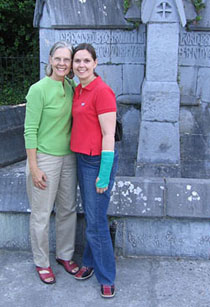 |
| Susan Williams and her daughter, Heather |
World Hunger Year’s focus on education and public policy reform is helping create the solutions to hunger that Harry sought for much of his life. At the time of his death he served as the Chairman of the Presidential Commission on Poverty and Hunger in Carter’s Administration. A folksinger, husband, father and good man… he went to Washington to see what he could do.
As I find you here again;
A thought runs through my mind;
Our love is like a circle;
Let’s go ’round one more time.”
Full Circle
Just like the lyrics for Harry’s song, “Circle”, Harry just keeps showing up in the most unexpected places. I am currently the Staff Writer for the Community Food Bank, Inc. that serves 170,000 people in southern Arizona. One of our rural branch banks - Amado Community Food Bank - received a Harry Chapin Self-Reliance Award this year! So, not only will I visit New York to attend the 25th Harry Chapin Run Against Hunger in Croton, but I will also accompany Tony Bruno, manager of Amado, to see him receive a WHY award on October 18th!
Wonders never cease. Since 1981, I’ve tried to live my life by conviction and like all humans I have not done so without flaw. But I live by my own intent now, not by another’s drum. Look what Harry accomplished in his short life! He left a legacy that reaches far and wide, and through the work of his family, fans, and World Hunger Year, the American conscience is changing.
I know that because Harry changed mine.
“Oh if a man tried
To take his time on earth
And prove before he died
What one man’s life could be worth
I wonder what would happen to this world”
- Harry Chapin’s lyrics
To read more of Susan’s writings, go to www.writeforchange.com.
Watch for the Next Issue of Circle! on December 7